

A personal trainer is primarily focused on fitness.
A movement specialist looks more closely at how a person moves.
Instead of simply asking, “What exercise should we do?” a movement specialist asks, “How is this person moving, and why?”
A personal trainer helps you get stronger and fitter.
A movement specialist helps you understand and improve how your body moves AND get stronger and fitter.
I don’t just prescribe exercises. I look at how you move.
I train your body to move in more than one direction just like real life. No one trips or reaches to catch something in a linear line.
I can recognize when an exercise isn’t serving you.
If I see a movement creating compensation, losing quality, or exposing a joint to unnecessary stress, I can modify the movement, change the exercise, or address the underlying limitation. The goal isn’t to force your body to perform an exercise. The goal is to improve your ability to move.
I am training you for the body you want to have years from now.
My goal isn’t simply to get you through a workout today.
I want to help you build strength, mobility, balance, coordination, stability, and movement confidence that continue to serve you as you age. Because the goal of fitness isn’t just looking fit or completing a workout.
I train movement, not just muscles.
I prepare you for the movements life actually demands.
Life doesn’t move in straight lines.
You rotate. You reach. You bend. You step sideways. You change direction. You catch yourself when you lose your balance. You push, pull, carry, lift, and move around obstacles.
If you repeatedly train your body in only a few predictable movement patterns, you may become very good at those exercises without necessarily becoming better at moving through life.
My job is to give your body a broader movement vocabulary.
I pay attention to how you perform an exercise, not simply whether you can complete it.
I don’t believe the answer to every problem is simply to get stronger.
I’m thinking about the 70-year-old, 80-year-old, and 90-year-old version of you.
I’m asking, “What do I need to help you maintain so you can continue doing what you love years from now?”
A movement coach prepares you for unpredictable movement.
A workout can be completely controlled and predictable.
Life isn’t. You trip, catch yourself, turn quickly, step sideways, reach from an awkward position, carry something unevenly, or change direction.
Training those abilities gives you a more adaptable body.
A movement coach doesn’t have to invent completely new movements to make someone stronger. They can take the movements a person already performs every day and teach them to perform those movements with better mechanics, better coordination, and greater strength.
A trainer can make you stronger at an exercise.
A movement coach can help you become stronger at moving.
Things I do as a movement coach that a personal trainer is not generally taught to do…
Individualizing an exercise instead of assuming the exercise is the answer
A movement specialist can take the same desired outcome and change the exercise based on the person’s body. Two people may both need stronger legs, but they may not need the same exercise, range of motion, stance, tempo, or progression.
Teaching people how to feel and understand their own movement
This is a big one. A movement coach isn’t just making someone perform an exercise correctly while they’re watching, they’re teaching them to recognize what good movement feels like so they can eventually make better movement decisions themselves.
Progressing movement complexity, not just resistance.
Traditional progression often means more weight, more reps, or more intensity. A movement specialist can progress someone by changing position, stability, coordination, range, direction, speed, balance, or complexity without necessarily adding weight.
Using exercise to improve everyday movement rather than keeping “exercise” and “life” separate.
If someone struggles getting off the floor, carrying things, stepping over something, reaching behind themselves, getting in and out of a car, etc., those aren’t just random exercises, Those are the movements you can train.
Knowing when NOT to progress.
This is an important specialty that gets overlooked. Sometimes the best progression isn’t heavier weight. It may be better control, better range of motion, better balance, or simply making the existing movement more efficient before adding another challenge.
Connecting mobility and strength rather than treating them as separate goals.
Instead of saying, “You need to stretch” or “You need to get stronger,” a movement coach can work on someone’s ability to control their body through the range of motion they have and progressively expand what they’re capable of controlling.
Training adaptability.
A machine or highly controlled exercise teaches the body to perform that task. Movement training can teach the body to respond when the environment changes: different surfaces, different positions, different loads, different directions, unexpected movements.
The goal is physical independence, not simply fitness.
This might ultimately be your biggest differentiator. Fitness asks, “How fit are you?” Movement specialization asks, “What can your body still do?” Those aren’t the same question.
Training for fall recovery and not just single leg balance
Having your body automatically respond when you unexpectedly catch your toe and start to fall is a bigger win than learning to stand on one foot and balance for 30 seconds.
A movement specialist doesn’t just train you to perform movements. They train your body to respond when movement doesn’t go as planned.
This is why my clients always FEEL so good not just strong!
They feel extremely capable and strong because our focus is MOVEMENT not just 3 sets of 10.



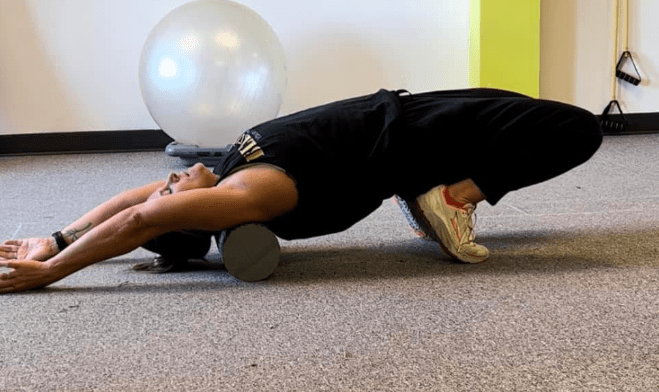



 Brenda Lee Lewis, Me, Mom, Trainer